BLOG
Interoperability: Your Simple Path to Success in Healthcare
Rich Piper
Interoperability is an eight-syllable technical term that is often used but can be confusing to many. In its simplest terms it means the ability to connect healthcare's disparate systems to communicate, exchange and use electronic health data efficiently, accurately and predictably. It's one of the most important initiatives for the industry today, demonstrated by the abundance of publicly accessible information on the topic. While it’s often perceived as cumbersome and costly, this is a myth. Interoperability is within reach and more accessible than ever.
The wealth of information available highlights the immense value of interoperability. However, practical guidance on executing a straightforward, pragmatic and time-bound implementation process is scarce. This short article aims to bridge that gap, helping you achieve better care coordination and improved patient outcomes.
Understanding Healthcare as a Community
Healthcare is fundamentally a community where a patient’s care is regularly transitioned across different sectors and settings. Care is delivered locally and crosses geo-political boundaries, requiring the seamless sharing of Protected Health Information (PHI). Each transition, regardless of distance, hinges on this exchange.
Exchange Technology
To effectively share PHI, both the sender and the receiver must have compatible technical capabilities, often referred to as the technical stack. Surprisingly, fax remains the most common modality for exchanging PHI among care organizations, despite its flaws. Fax lacks structure, security and identity verification, making it costly and error-prone. There is a better way.
Standards and Workstreams
National industry standards facilitate and normalize the exchange of PHI, regardless of the Electronic Health Record (EHR) system of choice. However, the multitude of exchange modalities and software manufacturers can be overwhelming, leading to decision paralysis. Moreover, many organizations struggle with poorly defined or nonexistent workflows, despite having the technical capabilities.
Simple and Pragmatic Steps to Operationalize
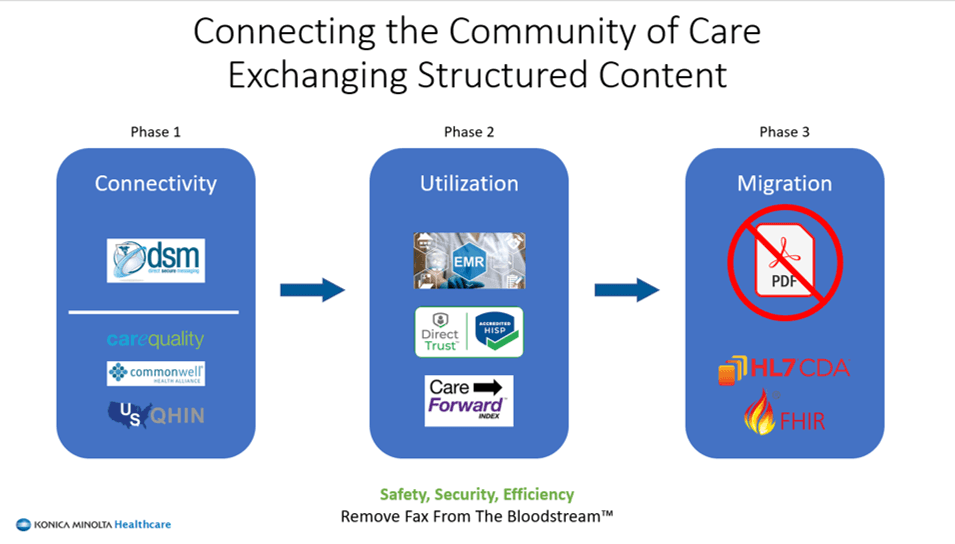
Connectivity: Begin by connecting with your peers using Direct Secure Messaging (DSM), a national encryption standard for securely exchanging PHI over the internet. Thanks to the HITECH Act and the Meaningful Use program, all Acute and some Ambulatory environments already have DSM capabilities.
Utilization: With DSM, you become a steward in your care community. Ensure your peers are aware of your new secure and effective capabilities. Inform your trading partners via phone or email. Some interoperability software companies offer tools to automate this process and provide access to the national directory of accredited Healthcare Information Service Providers (HISPs). Additionally, there are free indexes available to link your fax numbers to your DSM addresses, thus automating your digital transformation.
Migration: Build your network at your own pace and position yourself to leverage additional exchange capabilities like Carequality and Qualified Health Information Network (QHIN). Use Fast Healthcare Interoperability Resources (FHIR) protocols to ensure further accuracy and security. Utilize the Clinical Document Architecture (CDA) format, a popular and flexible markup standard.
In Summary
Interoperability is not difficult. Start your journey today to reduce costs, save time and mitigate HIPAA-violation risks by connecting with your peers.
Konica Minolta offers proven solutions and services to help care organizations begin, enhance and expand their interoperability initiatives. Learn more here.



Stay Ahead
Get the latest industry insights and trends delivered to your inbox.
Email Address
Advanced IT and Print Solutions for Modern Businesses. Empowering your digital transformation journey.
PRODUCT & SERVICES
Office Printers & Copiers
Production & Industrial Print
Scanners
Intelligent Information Management
Physical Security Solutions
Managed IT Services
BUSINESS SOLUTIONS
Workflow Automation
Data & Device Security
Workplace Print Services
Production & Industrial Print Solutions
INDUSTRY & SIZE
INDUSTRY
Healthcare
Legal
Education
Finance
Manufacturing
Government
COMPANY SIZE
Small Business
Mid-Size Business
Enterprise
NEWS & INSIGHTS
Blog
Case Studies
News Room
Resources Library
ABOUT US
Company Overview
Careers
Corporate Social Responsibility
Sustainability
Our Dealer Community
SUPPORT
Contact Us
Technical Support
Customer Resources
Advanced Integrations
Account Self Service
PRIVACY POLICY
TERMS OF USE
ACCESSIBILITY